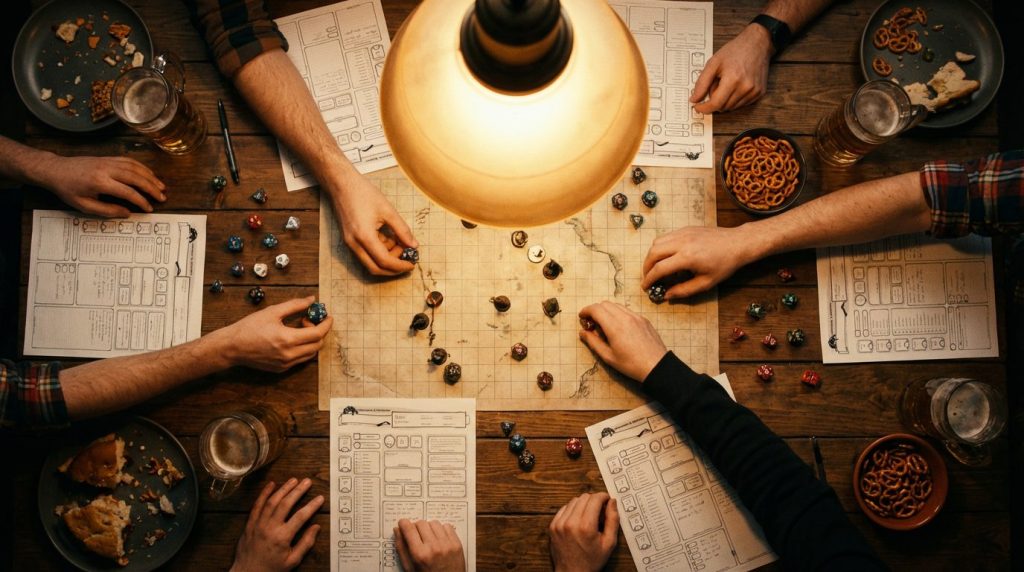
Stealing from history and myth isn’t about copying dates or gods line by line. It’s about borrowing pressure, belief, and contradiction. When you pull real-world ideas into an RPG world, players instinctively recognize patterns, even if they can’t name them. That familiarity makes the setting easier to inhabit and far more dangerous to ignore.
Why real history makes fantasy worlds easier to believe
History is full of bad decisions, half-measures, and unintended fallout. That’s exactly why it works so well for RPG worlds. Empires don’t fall because of prophecies. They collapse because of debt, pride, logistics, and internal rot. When you echo that logic, the game world starts behaving like a place instead of a stage.
At Geeknson tables, we’ve seen players latch onto worlds faster when power structures feel borrowed rather than invented. A senate that argues itself into paralysis or a border province quietly preparing rebellion doesn’t need explanation. It already makes sense. That familiarity speeds up immersion and lets you get to meaningful play faster.
Myth as emotional shorthand, not lore homework
Myth works best when used as emotional infrastructure. Flood myths, trickster gods, underworld journeys: players already know what these mean, even if the names change. You’re not retelling mythology, you’re tapping into shared instincts.
This is especially effective for worldbuilding tension. A society that believes its rulers descend from gods will tolerate cruelty differently than one built on merit or conquest. You don’t need to explain the theology in detail. Let rituals, taboos, and consequences show it. Players will fill in the gaps through roleplay, and that buy-in is gold.
Twisting the source so it stops feeling borrowed
The trick is distortion. Take one historical or mythic idea and break it slightly. Change the winner. Flip the moral. Delay the outcome. A war that never officially ended. A god that lost followers but not power. A revolution that succeeded and made things worse.
This keeps the world from feeling like a reskin. Players might recognize the bones, but the flesh is unfamiliar. That tension keeps curiosity alive. They stop guessing outcomes and start probing the setting. That’s when they treat the world as something to explore, not solve.
Let belief systems drive conflict, not geography
Maps are secondary. Belief is what causes friction. History shows this over and over: religions splitting, ideologies mutating, myths weaponized for control. Build cultures around what people think is true, not what actually is.
In play, this creates conflicts that don’t resolve cleanly. There’s no correct side, only competing narratives. Players arguing with priests, generals, or elders isn’t derailment. It’s engagement. The world pushes back because it believes in itself, not because the plot demands resistance.
Using history as a lens, not a rulebook
You don’t need accuracy. You need logic. Ask simple questions: who benefits, who loses, and who pretends nothing is happening. That alone will carry most scenes. Real history is messy, contradictory, and full of blind spots. Lean into that.
When players realize the world reacts in ways that mirror real human behavior, trust forms. They experiment more. They plan differently. They stop treating the setting like scenery and start treating it like a living system. That’s when inspiration turns into actual play value.
A practical example: turning history and myth into playable material
Let’s say you want a coastal region that feels old, tense, and quietly unstable. Instead of inventing everything from scratch, think in layers, the same way real history stacks itself.
Start with a historical pressure point: a trade city that grew rich controlling sea routes, then lost relevance when routes shifted. No catastrophe, just slow decline.
Add a mythic explanation layered on top: locals believe the sea god withdrew favor after a broken oath. Older families still perform rituals, younger ones mock them.
Introduce conflicting beliefs: merchants blame politics, priests blame faith, sailors blame everyone except the sea. Each group acts accordingly.
Show it through playable signals: empty docks, overzealous festivals, nervous guards, desperate deals offered to outsiders.
Let player involvement tilt the balance: backing one narrative strengthens it, undermining another creates backlash. No reset button.
This approach works because nothing here is exposition-heavy. Players learn by interacting. The setting explains itself through friction, not lectures, and the world starts responding like it has memory, pride, and fear.
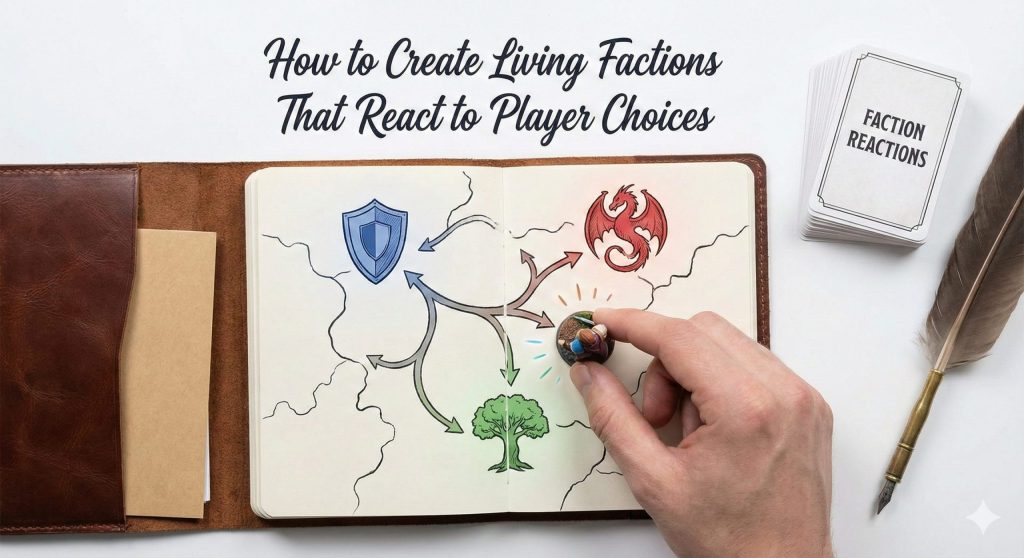
A living faction isn’t about lore dumps or color-coded flowcharts. It’s about pressure. Choices made at the table ripple outward, reacting inside the game world in ways players didn’t plan but instantly understand. At Geeknson tables, we’ve learned that when factions move, hesitate, or collide, players feel like the world moves with them.
Why factions are the fastest way to give your world real weight
A single faction can carry more narrative mass than ten locations. Why? Because a faction reacts to player actions even when the party isn’t watching. That’s what gives the world feel like something breathing instead of waiting. In roleplaying games, especially tabletop rpg sessions, factions are the engine of immersion. They create a living world where power shifts, rumors spread, and silence matters as much as action.
Think of factions as a collective with a shared value system, not a quest board. Each faction exists within the world, shaped by history, resources, and fear. When you think of factions this way, worldbuilding stops being decorative and starts driving gameplay. This is what makes factions matter and why the game’s tension survives between sessions.
From static NPC to moving pieces: what actually makes a faction feel alive
A faction should feel like a thinking organism. Not a logo. Not a uniform. One npc doesn’t define it, and neither do two npcs, even if they have great backstories. What matters is how the faction leader interprets events, how the commander’s priorities differ from the rank and file, and how the majority of the faction reacts under stress.
Ask yourself what the leader thinks when the pcs fail to intervene. That inaction is fuel. It creates meaningful consequences that ripple in-game. This is where player agency becomes visible. Players feel like their silence speaks. That’s the moment a faction might turn hostile, split, or seek another faction as backup. That’s how factions feel alive.
Start small: building your first faction without overdesigning it
Start small. One faction, one goal, one internal conflict. That’s enough. A tight faction system beats sprawling notes every time. Focus on motivations and goals, not history essays. A particular faction only needs to make sense within the type of game you’re running.
At Geeknson, we’ve seen 1 faction drive an entire arc simply because it was internally consistent. The rules for creating factions don’t need to be complex. A simple ruleset for how it gains allies, loses influence, or escalates violence is enough. This approach keeps coherence intact and leaves room for new factions to emerge naturally later.
Factions around the table: how npcs react when players choose inaction
When pcs don’t act, factions around them still vie for control. This is where enemy factions thrive. Faction politics doesn’t pause for heroes. Faction b might exploit a delay, while faction c negotiates in the shadows. Every faction watches, interprets, and adapts. This is pure factional dynamics. It makes players notice patterns. They start reading the room, tracking alliances and enemies, and anticipating fallout. Joining a faction becomes a real choice, not flavor. That’s when player choices truly shape the narrative and give the players ownership of outcomes.
When a quest changes the map: consequences that shape world feel
A quest should never end cleanly. Success shifts balance. Failure does too. That’s how worldbuilding becomes world-building in motion. One job completed for one faction might destabilize another faction entirely. This is how factions and their relationships evolve narratively. In a game like d&d or blades in the dark, borrowed game mechanics already support this thinking. Use them. Let faction abilities unlock or collapse based on outcomes. This is environmental storytelling at work. The world works because reactions stack logically, not because the plot says so.
Simple tools to manage multiple factions in interesting ways
You don’t need spreadsheets. A few tools to manage pressure is enough. Track who butt heads, who benefits, and who bleeds influence. That’s your faction system. Keep notes short. Update them after sessions. This preserves immersion without prep fatigue. Use examples of factions sparingly. Let players discover them through roleplay and consequence. Over time, different factions will feel different, shaped by player characters and the tone of your roleplaying. That’s how factions into your campaign stop being lore and start behaving like humankind: messy, reactive, and driven by fear and ambition.
Every long RPG campaign eventually hits this moment: the dice keep rolling, combat keeps escalating, and someone at the table quietly wonders whether this is still the story they signed up for. Figuring out how to balance combat and roleplay isn’t about maths or perfect pacing charts — it’s about understanding how tension, character choices and table energy actually work over time. At Geeknson, we’ve seen campaigns where too much combat turned sessions into a grind, and others where endless talking drained momentum from the game. The sweet spot lives in the ebb and flow between action and interaction, where your players feel challenged, heard and genuinely interested in the world unfolding in front of them.
Finding the balance between combat and roleplay in long RPG campaigns
Finding the right balance between action and conversation is one of the hardest parts of running a long campaign. Early on, everything works almost by default. Combat feels intense, characters are new, and even simple scenes generate excitement. Over time, however, repetition creeps in. Too much fighting turns encounters into routine. Too much talking drains urgency. This is where balance becomes a living process, not a fixed rule.
The key is understanding that combat and roleplay serve different emotional purposes. Combat creates pressure, risk and momentum. Roleplay creates meaning, attachment and consequence. When one dominates for too long, the other loses impact. A good long-term rhythm lets these elements feed each other instead of competing.
At Geeknson, we’ve seen this play out in real campaigns. Sessions that alternated between intense fights and quieter character-driven scenes kept energy high for months. Players stayed engaged because every fight mattered, and every conversation existed because of something that happened in combat. The story didn’t pause for action or dialogue — it moved through both.
The goal isn’t symmetry. Some arcs will lean heavily into combat, others into social play. What matters is awareness. When you notice fatigue setting in, that’s your signal to shift gears. Balance isn’t about counting minutes — it’s about maintaining tension, investment and momentum in your game over the long haul.
Why balance matters in RPG campaigns that last more than a few sessions
In the beginning, everything feels fresh. Combat is exciting, victories feel earned, and every encounter carries weight. But as a campaign stretches over months or even years, patterns start to emerge. If every session leans too hard into fights, combat slowly stops feeling special. If everything turns into discussion and planning, tension leaks out of the game. That’s why balance isn’t a one-time decision — it’s something you adjust constantly, often without even announcing it.
What matters most is how the players experience time at the table. Long stretches of combat-heavy play can exhaust even players who love tactics, while long roleplay-only arcs can leave others restless. The goal isn’t to split sessions fifty-fifty, but to create rhythm. Action followed by consequence. Conflict followed by reflection. This is where combat can be more than mechanics and roleplay becomes more than talking.
At Geeknson, we often joke that you can hear when balance is off. Dice roll slower. Side conversations start. Someone checks their phone. When your players are engaged, though, the table is alive — even during quieter scenes. A well-paced campaign uses combat to raise stakes and roleplay to let the characters process what just happened, grounding the action in the world they care about.
Get that rhythm right, and combat stops being filler, conversations stop dragging, and the whole experience feels intentional — for everyone around the table.
How your players experience combat versus roleplay over time
Over a long campaign, the way your players perceive combat and roleplay changes more than many GMs expect. What feels exciting in the first few sessions can feel very different after dozens of hours at the table. Understanding this shift helps you adjust how you run the game before boredom or frustration creeps in.
Here’s what usually happens over time:
Early sessions: Everything feels new. Combat is thrilling because stakes are unclear, rules are still settling, and every fight teaches the table something about the characters and the world.
Mid-campaign: Players become more competent. Combat encounters start to feel familiar, especially if they follow similar patterns. This is often when players become more invested in motivations, relationships and consequences rather than raw mechanics.
Late campaign: Players care deeply about outcomes. Combat is no longer just about winning — it’s about why the fight happens and what it changes. Fights without narrative weight can feel empty, while meaningful confrontations land harder than ever.
Different players react differently:
some players enjoy combat as a tactical puzzle and want it often,
others engage most in roleplay, watching how decisions shape the game,
many want both, but in a rhythm that respects their time and attention.
The important part is noticing when energy shifts. If the players start skipping descriptions, rushing turns, or disengaging during fights, it’s a sign combat is losing impact. If long conversations stall momentum, it may be time to introduce pressure, danger or action.
Balance comes from observation, not formulas. When you pay attention to how players react at the table, you’ll know what to dial up – and what to ease back – to keep everyone invested for everyone involved.
Using combat to support the story, not interrupt it
Combat works best when it has a reason to exist. A fight that grows naturally out of player choices strengthens the story, while random battles often feel like interruptions. When combat reflects tensions in the world, unresolved conflicts, or mistakes made earlier, it stops being filler and starts carrying meaning.
Short, focused encounters can reinforce stakes, reveal character values, and push consequences forward. When players understand why they are fighting, combat becomes part of the narrative flow instead of a pause button on the plot.
Letting roleplay shape encounters and change the game
When roleplay is allowed to influence events, combat encounters stop being fixed scenes and start evolving naturally. What players say, who they trust, and how they treat NPCs can completely change what happens next. In this way, roleplay becomes a tool that actively reshapes the adventure, rather than something that happens only between fights.
This approach works especially well when the players realise that their choices carry weight in the world. A tense negotiation might turn an enemy into an ally. A careless insult can escalate a minor conflict into a dangerous combat encounter. Sometimes, combat can be avoided entirely because players found a smarter or more human solution. That’s not skipping content – that’s good play.
For the GM, this means being flexible with the game. You don’t lock encounters in place; you let them breathe. If the players approach a situation differently than expected, you adjust difficulty, goals, or even the purpose of the fight. Over time, this creates a natural balance where combat and roleplay feed into each other instead of competing.When roleplay shapes encounters, players stop asking “is this the next fight?” and start asking “what will our choices cause?”. And that shift is what keeps long campaigns engaging, unpredictable and emotionally grounded – for everyone at the table.
Every side quest starts the same way: someone in a tavern asks for help, the party sighs, and everyone secretly wonders if this will be fun or just feel like a chore. The difference between a forgettable detour and one of the best side quests isn’t length or rewards – it’s intent. At Geeknson, we’ve seen players abandon the main quest without hesitation when a side story hits the right notes. Done well, a side quest doesn’t pull you away from the main story – it makes the whole world feel more alive, more immersive, and much harder to leave behind.
What makes a compelling side quest worth following
A compelling side quest isn’t something players do because it’s there. It’s something they follow because they want to. In tabletop sessions at Geeknson we’ve seen it countless times: the party ignores the obvious hook for the main quest, but instantly locks onto a side quest that promises drama, chaos or a genuinely interesting story. So what actually makes that happen?
Here are the elements that separate a great sidequests from a bad sidequest:
It has a clear goal for the players. Players need to know why they’re doing this. Not just “go kill” or kill x, but a reason that sparks curiosity or emotion. A quest needs intent, not busywork.
It connects to plot and characters. The best side quests don’t float in a vacuum. They echo the main plot, deepen story and characters, or subtly comment on themes of the main story.
It avoids the classic fetch quest trap. A pure fetch quest where you just fetch, return and collect loot feels like MMO filler. Add a twist, a choice, or an interesting resolution, and suddenly the same structure becomes engaging.
NPCs matter. One memorable npc or a small group of npcs can carry an entire side quest. A grumpy alchemist, a suspicious tavern owner, or a grizzled veteran with unfinished business instantly raise the stakes.
It feels like a reward in its own right. The best side quests aren’t about the rewards you get — the experience is the reward. Players remember the moment, not the gold.
A side quest works when it feels optional, but irresistible. When players choose it over the obvious path, you know you’ve nailed the design.
Using side quests to develop plot and characters
The smartest way to use side quests is to treat them as pressure tests for the main plot and character arcs. A good side quest doesn’t compete with the main story – it reflects it. It asks the same questions from a different angle, often with lower stakes but sharper consequences. That’s how side content becomes meaningful instead of decorative.
Think about plot and characters as something elastic. A side quest can pull on that elastic and show what snaps. Maybe it reveals a moral line a character won’t cross. Maybe it forces a choice that mirrors the main quest in miniature. In rpgs, this is gold: players learn who their characters are by making decisions when nothing is must be completed and no cutscene forces their hand.
At Geeknson tables, we love side quests that send the player slightly away from the main, into a new area or a small dungeon, just long enough to complicate things. One conversation with an npc can reframe how the party feels about the conflict. One favor done “on the side” can ripple back into the main plot later. That’s when players start to care about the main arc more, not less.
This is also where a quest chain shines. A short series of quests lets consequences stack naturally. What starts as a simple favor can grow into something much bigger, shaping alliances, grudges, and expectations. It’s subtle quest design, but incredibly effective game design for long campaigns.
When side quests develop story and characters, they stop being detours. They become connective tissue – the quiet work that makes the world feel coherent, reactive, and alive.
From one hook to a quest chain players care about
Most side quest disasters start small – a cool hook that goes nowhere. One scene, one job, done. Players shrug and move on. If you want a hook to grow into a quest chain players actually care about, think continuity, not scale.
A simple pattern works wonders:
Start personal, not epic. One request, one problem, one choice. Something that feels low-stakes but human. This is where players decide if they’re emotionally buying in.
Let consequences linger. The outcome of that first side quest should change something. An NPC reacts differently. A door opens. Another closes. Suddenly the world remembers.
Escalate sideways, not upward. Instead of “bigger monster, more loot”, complicate the situation. Conflicting interests. Moral friction. Someone else wants the same thing.
Call back when they least expect it. Nothing sells a quest chain like recognition. When players realise a past decision just resurfaced three sessions later, engagement spikes instantly.
At Geeknson tables, this is where side quests stop feeling optional and start feeling inevitable. Not because the GM forces them – but because players want to see how their choices play out. One hook becomes a thread. The thread becomes a story. And suddenly, that “little side thing” matters just as much as the main plot.
How to use side quests without derailing the main story
Side quests only derail the main story when they exist in a vacuum. The fix isn’t fewer side quests – it’s smarter placement. A good side quest should feel like a lens on the main plot, not a hard left turn into unrelated content.
Here’s the simple rule we use at Geeknson: a side quest should change context, not direction.
Anchor side quests to the same stakes. Different angle, same pressure. Let the side quest echo themes, factions or consequences tied to the main quest.
Time-box the detour. Keep scope tight. One location, one dilemma, one payoff. Players feel free to explore without losing momentum.
Let outcomes feed forward. Information, allies, grudges or resources gained on the side should subtly reshape what comes next in the main arc.
Avoid mandatory “must be completed” flags. Optional content stays optional. When players choose the detour, it energizes the table instead of stalling it.
Done right, a side quest doesn’t pull the party away — it adds weight to where they’re going. The story stays focused, the world feels reactive, and players never feel like they’re grinding filler on the way to the real plot.
Running a mystery in an rpg sounds simple until the clues start pointing in directions you didn’t plan. This is usually when anxiety kicks in, what notes get rewritten mid-session, and the players suddenly decide to interrogate the one NPC you thought was just background. Railroading often sneaks in at this exact moment – not because you want control, but because you’re afraid the mystery will fall apart without guidance. The real challenge isn’t how to hide clues, but how do you let the players investigate freely without railroading, while still making sure the story holds together and the game doesn’t stall.
What railroading really is – and why the players feel it immediately
Railroading is not about having a story. Railroading is about deciding what happens no matter what the players do. The moment choices stop mattering, the table feels it. The players might not name it, but they sense when outcomes are locked, clues only work one way, and every path leads to the same scene in the same dungeon corridor.
The problem isn’t preparation. The problem is control. When the GM treats the adventure like a script instead of a situation, the players are no longer participants – they’re passengers. And once that happens, engagement drops fast. Even in mystery-based RPG adventures, curiosity dies when the solution is predetermined and every wrong turn is quietly corrected behind the screen.
Railroading is tempting because it feels safe. It protects pacing, plot points and your cool reveal. But the cost is agency. And without agency, mystery turns into homework instead of discovery.
A good mystery doesn’t ask “Did you follow the plan?” It asks “What will you do with what you’ve learned?”
Clues as tools, not instructions – how to guide the players without forcing them
In a mystery-based RPG, clues aren’t meant to push the players down a single correct path. They’re meant to give them leverage. The moment a clue only works in one specific way, you’re halfway back into railroading, even if the plot feels clever on paper. Good clues don’t say “go here next” – they say “here’s something interesting, now decide what to do with it.”
The trick is redundancy without repetition. You can point toward the same truth from different angles: rumours, physical evidence, NPC behaviour, inconsistencies in the environment. When the players miss one clue, the mystery doesn’t stall – it simply reveals itself elsewhere. That’s how you avoid railroading while still keeping momentum.
As the GM, your job isn’t to protect the solution. It’s to protect curiosity. If the players start arguing about theories, chasing the wrong lead, or splitting up to test ideas, you’re doing it right. Mystery lives in uncertainty. Control kills it.
A strong mystery doesn’t funnel the party toward answers. It creates a space where the players feel smart for connecting dots – even when those dots weren’t part of your original plan.
Clues should point forward, not push sideways
A mystery stays alive when the players feel they are uncovering something, not being nudged toward it. The safest way to avoid railroading is to design clues that open options instead of closing them. A clue shouldn’t say “go here next” – it should say “here’s something interesting, now decide what to do with it.”
In practice, that means clues that can be used in more than one context. A torn journal page might point to a location, a person, or a hidden motive. A strange symbol found in the dungeon could be tied to a faction, a ritual, or a past failure. When you do this, the players can argue, theorise, split up, or completely misinterpret the evidence – and that’s good. Misinterpretation is still engagement.
Railroading happens when the GM treats clues like keys for a single lock. If the only correct response is the one you planned, then discovery becomes a test, not play. If the players surprise you with a different conclusion, let the world respond instead of correcting them. Sometimes the wrong theory creates a better adventure than the right one.
A mystery works without force when the story adapts to player logic. You don’t need to hide the truth on a single path – you need to let the truth be approached from many angles. That’s the difference between guiding a mystery and dragging the party through it.
Clues as tools, not instructions – practical ways to guide without railroading
In mystery-based RPG adventures, clues should open possibilities, not close them. The fastest way into railroading is treating clues like keys that only fit one lock. If the players miss it, the story stalls. If they find it, they’re pushed down a single narrow path. That’s not mystery – that’s choreography.
Here’s how to handle clues in a way that keeps the players engaged without taking control away:
Design clues that point to information, not conclusions. A bloodstain tells you something bad happened. It doesn’t tell you who did it. Let the players decide what it means.
Place the same clue in multiple forms. If the party skips the library, the rumour appears in a tavern. If they avoid the barkeep, they find a letter. The truth survives different approaches.
Let wrong theories move the story forward. When the players jump to a false conclusion, don’t correct them immediately. Show consequences. Adjust the world. Mystery thrives on momentum, not accuracy.
Reward curiosity, not obedience. If the players investigate something you didn’t plan for, give them something. It doesn’t have to be the answer – just proof that their choice mattered.
Think in terms of “what happens if…” Instead of planning scenes in order, plan reactions. What happens if they accuse the wrong suspect? What happens if they ignore the obvious clue?
This approach lets the GM protect pacing while still respecting agency. The story moves because the players act, not because they guessed what you wanted.
A mystery works best when the table feels like they’re discovering the truth – even if you’re quietly adjusting things behind the screen to keep the world coherent.
That’s not railroading. That’s good mystery design.
Letting go of control without losing the story
The hardest part of running mystery-based RPG adventures isn’t improvisation — it’s trust. Trust that the players will engage, that the story will survive contact with chaos, and that you don’t need to control every outcome to tell something meaningful.
When you loosen your grip, something interesting happens. Players start taking ownership. They connect dots you never planned. They argue, speculate, get things wrong, then surprise you by being right in a completely different way. That’s not a problem — that’s the point.
Railroading is about fear: fear of wasted prep, fear of broken pacing, fear that the story will fall apart. But mystery doesn’t fall apart when players choose differently. It falls apart when choices don’t matter.
If the table feels like they’re uncovering the truth together, you’re doing it right. If they feel like they’re being guided toward the “correct” answer, you’ve already lost them.
A great mystery doesn’t end when the GM reveals the solution. It ends when the players realise they figured it out themselves.
Every dungeon master knows the feeling: you introduce an npc, expecting a quick exchange, and suddenly the table goes quiet. The players lean in. Someone asks a follow-up question. Congratulations – you’ve just stumbled into what makes npcs work. In a tabletop rpg, rules matter, plots matter, but it’s the people inhabiting the world that create immersion. When done right, memorable npcs stop being background noise and start driving the story forward.
Creating an NPC with goals and motivations – more than just backstory
When people talk about creating an NPC (non-player characters), they often start with a tragic backstory. Dead parents, burned village, vague thirst for revenge – you’ve seen it all. But here’s the thing: players rarely care about what happened before the session. They care about what the NPC wants right now. To create memorable, you need intent, not trauma.
A strong npc starts with goals and motivations, even simple ones. A barkeep might just want to keep their tavern running. A friendly npc could be trying to impress a local adventurer. A slightly pompous noble may be desperate to prove they’re not just riding the coattails of the so-called chosen one. These desires shape how NPCs react, negotiate and lie – and suddenly they feel like they belong in the game world.
At Geeknson, we’ve seen it happen dozens of times: the dungeon master’s carefully planned quest gets completely sidelined because the players latch onto a new npc with a clear personal goal. That’s not a failure – that’s success. That’s how a campaign starts to grow and change organically.
To make an NPC stick, ask yourself:
something they want,
something they’re afraid to lose,
and how far they’ll go to get it.
You don’t need pages of lore. You need a direction. Once an npc knows what they’re chasing, they become a catalyst for memorable moments, whether they’re helping the PCs, complicating the adventure, or quietly pulling strings in the background.
This is how you make memorable npcs: not by writing novels, but by giving them momentum.
Give them a distinct mannerism and quirk – how NPCs make your world feel alive
If there’s one rule every NPC should follow, it’s this: it’s the little things that make players care. You don’t need pages of lore or a complex stat block to make someone stick. What you need is a hook the table can feel immediately. A repeated gesture. A strange habit. A way of speaking that makes heads turn the moment you open your mouth.
Give them a distinctmannerism and a single, clear quirk. That’s often enough to turn a forgettable shopkeeper into one of the most interesting NPCs in the campaign. Maybe the barkeep never makes eye contact and polishes the same glass over and over. Maybe a pompous noble pauses dramatically before every sentence. Maybe a nervous halfling laughs at their own jokes a second too late. These details take seconds to invent, but they do real work at the table.
At Geeknson, we’ve noticed that when npcs behave consistently, players start treating them like real entities instead of quest dispensers. A friendly NPC with a recognizable habit will be remembered long after a perfectly balanced encounter is forgotten. This is how NPCs in D&D and other systems start to feel like real people, not just functional obstacles.
The trick isn’t realism. It’s recognisability. When you make an npc immediately readable, the game world gains texture and personality. Players don’t ask “what do they do?” – they ask “what’s their deal?”. And that’s the moment your world starts to breathe.
You don’t need dozens of traits. One strong signal is enough to make npcs helps anchor scenes, spark roleplay, and quietly pull your campaign to life.
Every NPC needs a personal goal – even if NPCs might never reveal it
If you want every NPC to feel alive, give them something they want. Not a speech, not a monologue, not a dramatic reveal – just a personal goal quietly ticking in the background. This is one of the simplest ways to turn flat NPCs into characters your players instinctively care about.
A personal goal doesn’t have to drive the main adventure, and it doesn’t even need to be visible. NPCs might never say it out loud. But it should shape how they act, what they avoid, and how they react when the pcs push too hard. A friendly npc who wants to protect their family will hesitate before helping. A villainous contact who wants power will overpromise and underdeliver. Motivation leaks into behaviour whether players notice it or not.
At Geeknson tables, we’ve seen this work over and over again. The moment an npc stops existing “for the party” and starts existing for themselves, the game world clicks. Conversations gain tension. Choices feel weighted. Suddenly, the world isn’t waiting to be interacted with – it’s already moving.
Think of it this way:
the chosen one has a destiny,
but everyone else has a goal.
That goal might be small, selfish, noble, or embarrassing. It might involve money, pride, fear, or a dark secret they’re desperately hiding. Whatever it is, it gives the NPC a memorable inner logic. And logic is what allows players to predict, manipulate, trust or betray them.
You don’t need complex backstories or elaborate planning. One sentence is enough:
“This person wants X, but Y is in the way.”
That’s it. That’s the engine.
When goals and motivations drive behaviour, NPCs helps the story without forcing it. They react naturally to pressure, refuse unreasonable demands, and occasionally surprise the table by choosing themselves over the party. Those moments create tension, and tension creates memorable moments.
An npc without a goal is decoration. An npc with a goal is a decision waiting to happen.
Dynamic NPCs at the table – improvise, roleplaying and unpredictability
Static NPCs exist to deliver information. Dynamic NPCs exist to react. The difference is massive. When an NPC responds emotionally, changes their mind, or makes a bad decision under pressure, the table immediately pays attention. That’s when players stop treating conversations like dialogue trees and start treating them like relationships.
At the rpg table, this means letting go of rigid scripts. As a dungeon master, you don’t need to predict every response – you need to improvise based on what just happened. Did the party insult the wrong noble? That NPC doesn’t forget. Did they save someone unexpectedly? That gratitude can grow into loyalty, obsession, or future trouble. This is where roleplaying becomes a shared performance, not a checklist.
Unpredictability doesn’t mean randomness for its own sake. It comes from consistent personalities placed under stress. A calm scholar might snap. A confident guard might hesitate. A reliable ally might make a selfish choice when cornered. These moments feel real because they mirror human behaviour, not plot convenience.
We’ve seen it countless times at Geeknson tables: players remember NPCs who surprised them, not the ones who explained things clearly. A world feels alive when NPCs argue back, change plans, and occasionally make everything worse – just like the players do.
NPCs can provide more than a quest – helping the dungeon master make them stand out
Too many npcs exist only to hand out a quest, point toward a dungeon, and fade into the background forever. That’s efficient – and instantly forgettable. If you want interesting npcs that spark memorable moments, let them do more than dispense objectives. A strong npc is a catalyst: they complicate plans, challenge assumptions, and pull the player characters into choices they didn’t expect.
For a dungeon master, the trick is to stop treating quest-givers as vending machines. NPCs can provide leverage, consequences, and emotional stakes. A friendly npc might ask for help, then quietly betray the party to protect something they want. A villainous contact might offer aid for selfish reasons. These twists don’t require a full stat block or perfect stat balance – they require intention. It’s the little things that make great npcs: a favor owed, a debt collected, a promise broken.
At Geeknson, we’ve seen tables light up when npcs helps the party and complicates the adventure at the same time. That’s when make them stand becomes more than advice – it becomes practice. Give the npc a reason to stay relevant after the first scene. Let them return changed. Let them grow and change alongside the pcs. When an npc influences plot points instead of just pointing at them, the game world starts to breathe.
If you want to create memorable npcs, think beyond tasks. Think impact. A good npc doesn’t just start a story – they keep pushing it forward.
AI has barged into tabletop RPGs faster than a rogue spotting an unlocked chest. For some tables it’s a handy sidekick, for others it feels like an uninvited guest trying to nick the game master’s chair. Tools like ChatGPT can spin up NPCs, plot hooks and whole regions in seconds, but they can also sand down the rough edges that make storytelling at the table feel alive: the chaos, the daft decisions, the human timing. And yes — we at Geeknson had our own heated debate over whether AI is a helpful familiar or a chaotic neutral intruder trying to join the party without rolling stats. So before we let an algorithm sit in on our next session, it’s worth asking what it really does to RPG role play — and why the results aren’t always as magical as the pitch.
When AI joins the table: new tricks, new traps
AI tends to show up in RPGs like a new player who swears they’ll “just help with notes” and suddenly wants to co-write the campaign bible. Sure, it can whip up a town, three plot hooks and a shady merchant faster than you can say roll initiative. But it also has a habit of making everything sound like a pre-written module — tidy, polished, and suspiciously similar no matter the setting.
RPGs thrive on messy storytelling, wild pivots and players doing things no sensible storytelling system would ever predict. An algorithm can provide inspiration, but it has no idea what to do when the party decides to interrogate a scarecrow or form a union among dungeon monsters. We’ve seen this ourselves at Geeknson — someone fed an AI a basic town prompt and somehow every tavern ended up with “a mysterious aura and a secretive barkeep”. Not wrong… just hilariously copy-pasted.
So yes, AI can help. But much like giving a wizard explosives, the question isn’t “can it?”, it’s “should it?”.
A game master with “sixth sense” or a GM running on autopilot?
AI can feel like a cheat code for a busy game master. Need an NPC on the fly? Boom — name, attitude, tragic backstory included. Need a description of a ruin the party definitely wasn’t supposed to explore? Done. It’s tempting to let the algorithm sit on your shoulder like a digital familiar whispering suggestions.
But a table doesn’t run on tidy logic or neat game mechanics. It runs on chaos, instinct and whatever the bard decides to do after taking “just a small sip” from the cursed bottle. If the GM starts leaning too heavily on AI, the session slowly shifts into algorithm-approved storytelling — clean, tidy, and strangely lifeless.
We found this out the funny way — one of our team GMs tried using AI mid-session to improvise NPC dialogue, but the moment the bard started flirting with a mimic, the model absolutely short-circuited. Turns out no algorithm is ready for the sheer nonsense of a real party’s decisions.
AI can absolutely assist. But if it starts steering instead of supporting, the session loses that spark only a human GM can create.
AI-generated characters – genuine depth or beautifully packaged sameness
AI is fantastic at jump-starting character ideas — motives, flaws, dramatic childhood trauma, the whole package. But after a while, you start noticing a pattern: everyone suddenly has a tragic past, a shadowy mentor and a quest for redemption. That’s the “algorithmic origin story” effect.
What AI does well:
gives you a clean personality outline in seconds,
offers quick emotional hooks for storytelling,
helps players break through creative block,
suggests roles that fit neatly into the party structure.
What AI consistently struggles with:
the weird human quirks that fuel memorable role play,
those tiny details only a player can invent (like a barbarian obsessed with spoons),
capturing the chaotic energy of a table full of people winging it,
creating characters who feel unique rather than “AI-approved”.
Used right, AI is a great launcher — but players still need to add the flaws, oddities and deranged personal choices that earn real experience points in character depth.
Improvisation vs the algorithm – where spontaneity takes the lead
Improvisation is the soul of tabletop RPGs. A calm tavern scene can explode into a full-blown political revolt because someone rolled a natural 20 on convincing the innkeeper to unionise. No storytelling system — no matter how refined — can predict that sort of table chaos. And we’ve seen it firsthand at Geeknson: during one of our lunchtime sessions, the party accidentally founded a workers’ guild in a bakery. The AI froze harder than a low-level wizard in front of a dragon.
Where AI tends to fall short:
it pushes neat, predictable outcomes,
nudges players toward “optimal logic”,
smooths out the gloriously stupid choices that make sessions legendary,
can’t react to four players shouting different plans at once.
Where humans always win:
brilliant, panic-driven improvisation,
spontaneous group chaos (“WAIT, I HAVE AN IDEA!” x4),
character-led madness that breaks the script,
creating moments no algorithm would dare propose.
AI can hand you options. But good storytelling often comes from ignoring them entirely and diving face-first into the chaos the table creates.
AI as a worldbuilder – wide-open sandbox, but is it truly alive?
AI can build a world frighteningly fast. Hand it a few prompts and you get kingdoms, factions, legends, a detailed map and three cults with suspiciously dramatic robes. It feels like having your own pocket rpg maker, ready to churn out settings on demand.
But here’s the catch: AI-built worlds tend to be correct. Polished. Sensible. They run on internal logic — not on the beautifully deranged energy of real players poking holes in everything. A world generated by an algorithm is easy to explore, but harder to break, and breaking worlds is half the fun.
A truly living sandbox grows through player action: the wizard accidentally becomes mayor, the paladin starts a cheese cult, the rogue befriends the dungeon’s mimic instead of stabbing it. AI can’t foresee this, because it plans for probability, not chaos. And in tabletop RPGs, chaos is practically a currency.
AI is a great assistant to a game master, but the table is what breathes life into a setting. Without human nonsense, it’s just a tidy draft pretending to be a world.
The future of RPG storytelling – partnership or a fight for the soul of the table?
AI isn’t disappearing. It’ll keep helping sketch characters, speed up prep and offer prompts when inspiration runs dry. But it will never replace the spark that happens when real humans sit around a table, roll badly, argue loudly and steer the story into places no algorithm would dare predict. And trust us — we’ve tested AI behind the scenes. It’s helpful, clever even, but nothing compares to the energy in the room when someone slams a d20 on one of our tables and everything suddenly changes.
The future looks less like “AI taking over the table” and more like “AI staying politely in the backpack until someone needs it”. A tool, not a storyteller. A sidekick, not the hero. The kind of magical item that gives +1 to prep time but absolutely no bonus when the plan catastrophically falls apart during live role play.
Nothing replaces the collective imagination of players determined to bend the world to their will. No AI can replicate the laughter after a disastrous roll, the chaos of a bad idea executed brilliantly or the human instinct to challenge the game mechanics just to see what happens. The story belongs to the table — always has, always will.
You know that moment. Everyone’s sitting around the table, dice ready, and someone finally asks: “So… who’s running this?” Crickets. Suddenly those character sheets become absolutely riveting.
Here’s the thing – being a Game Master isn’t nearly as scary as you think. Honestly? It might become your favorite part of tabletop gaming. I’ve spent countless hours behind the screen, and I’m telling you: this role transforms good game nights into the ones you’ll remember forever.
Understanding what a Game Master actually does
A Game Master – sometimes called a Dungeon Master in D&D, a Storyteller in World of Darkness, or a Keeper in Call of Cthulhu – is the person who makes everything happen. But what does that mean when you’re actually at the table?
Think part referee, part storyteller, part improv actor, part world-builder. You’re not playing against your players (despite what some folks think). You’re there to create an incredible shared experience. You describe what the characters see, hear, and encounter.You become the shopkeeper haggling over potion prices, the dragon guarding its hoard, and the mysterious stranger offering a quest in a dimly lit tavern.
The game flows like this: players tell you what their characters want to do, you describe what happens, they react, and the story unfolds. It’s collaborative storytelling where dice rolls and imagination collide to create moments you’ll talk about for years.
The core responsibilities that matter
Running a tabletop RPG means wearing several hats at once. You manage the non-player characters that populate the game world – everyone from friendly innkeepers to terrifying villains. These NPCs breathe life into the setting and give players something to interact with beyond combat.
You also track the general state of the world. When players ask “Is there a cart nearby?” or “Does this town have a blacksmith?”, you’re making those calls. Sometimes you’ve planned these details meticulously. Other times, you’re improvising on the spot. Both work beautifully.
Rule interpretation falls on your shoulders too, though this doesn’t mean memorizing every page of the rulebook. The best game masters know the core mechanics solidly and can make fair, consistent rulings when edge cases pop up. If something’s unclear mid-session, make a quick decision and look it up later. Keep the game flowing – that matters more than perfect accuracy.
Skills every GM develops
Let’s be real about what makes a great game master. You don’t need Matt Mercer’s voice acting chops. You don’t need encyclopedic knowledge of every rule. What you do need are these fundamentals that anyone can develop with practice.
Storytelling and narrative building
Every epic campaign starts with a spark. Maybe it’s a cool concept from a movie, a twist on a classic fantasy trope, or just a “what if?” question that won’t leave your mind. You craft narratives that give players a reason to care, situations that challenge them, and moments that make everyone lean forward in their seats.
The trick is finding balance. Create enough structure so the story has direction, but leave plenty of room for players to surprise you. They will. Trust me on this – they absolutely will take your carefully planned three-hour dungeon crawl and somehow end up negotiating with the goblin king to start a small business instead. And that’s perfect.
Plot hooks work best when they connect to what your players care about. During your session zero (we’ll get to that), pay attention to what excites them. If someone mentions their character is searching for a lost sibling – boom, there’s your subplot. Weave these personal threads into the larger narrative, and watch your players become invested in ways that surprise even you.
Improvisation – your secret weapon
Here’s what nobody tells beginners: improvisation matters more than preparation. You can spend hours crafting the perfect encounter, and your players will immediately do something you never anticipated. That’s not a bug, it’s a feature.
Good improvisation starts with listening. When your players suggest something unexpected – “Is that merchant actually the Duke’s long-lost brother?” – you have options:
say yes and run with it, incorporating their idea into your narrative,
say “not quite, but…” and redirect slightly,
embrace the uncertainty and let dice decide.
I keep a few tricks ready for improvisation. Random NPC names? Have a list. Need a quick encounter? Keep some flexible combat scenarios prepared. Players want to investigate something you didn’t plan for? Describe sensory details while your brain frantically figures out what they find. This gets easier with every session, I promise.
The “Yes, and…” principle from improv theater works wonders at the gaming table. When players pitch creative solutions, find ways to make them work within reasonable boundaries. Did the rogue want to swing from the chandelier to kick the villain in the face? That’s not in the rulebook, but it’s cinematic as hell. Don’t make them roll if it’s cool and doesn’t break your game. Just let it happen and watch your table explode with excitement.
Managing rules without drowning in them
You need solid understanding of your game system’s core mechanics – how characters do things, how challenges get resolved, how combat flows. But here’s the secret: you don’t need to know everything before your first session.
Focus on the basics. Understand task resolution, know how your game handles conflict, and grasp what tools the system gives you for pacing and challenge. Everything else you can learn as you go. Keep a cheat sheet nearby for frequently used mechanics. Bookmark important sections in your rulebook. Use sticky notes liberally.
When rules questions pop up mid-session, make a quick ruling that feels fair and move on. Write it down, research the actual rule later, and clarify for next time. Flow matters more than perfect accuracy in the moment. Your players would rather keep playing than watch you thumb through indexes for five minutes.
Different game systems have different philosophies. Some, like D&D and Pathfinder, have extensive rules covering many situations. Others, like Powered by the Apocalypse games, focus on narrative flow with lighter mechanics. Choose what fits your style and your group’s preferences. There’s no wrong answer here.
Your first steps behind the screen
Ready to take the plunge? Here’s how I recommend starting your game mastering journey without overwhelming yourself.
Choosing your first game system
This decision matters, but it’s not as critical as some make it sound. Start with what you know. If you’ve played a particular system as a player, that familiarity gives you a huge head start. You already understand how the game flows and what players expect.
For complete beginners, I suggest starting with systems that have strong beginner support. The D&D 5th Edition Starter Set walks both new players and new game masters through the basics step-by-step. It includes pre-generated characters, a solid introductory adventure, and simplified rules to get you playing quickly.
Other fantastic options include systems specifically designed for easy entry. Some games focus more on storytelling with lighter rules overhead, which can reduce the cognitive load during your first sessions. Browse a few options, read some reviews, maybe watch an actual play video or two, and pick what resonates with your gaming vision.
Starting with pre-made adventures
Listen, I love homebrew campaigns as much as anyone. Building your own world from scratch is incredibly rewarding. But for your first time behind the screen? Use a published adventure. Here’s why:
Pre-made adventures give you a template for pacing, encounter design, and narrative structure. They show you how experienced designers think about sessions. You’ll see how to balance combat with social interaction, how to drop plot hooks naturally, and how to structure scenarios that give players meaningful choices.
Many starter adventures are specifically marked as beginner-friendly. These usually feature well-defined settings, straightforward plots, and guidance for common situations. They anticipate questions new game masters might have and provide answers. Plus, you’ve got entire online communities who’ve run the same adventure and can offer advice if you get stuck.
Does this mean you can’t improvise or make changes? Absolutely not. Treat published adventures as frameworks, not scripture. Change names, adjust encounters to match your group’s power level, skip sections that don’t grab you, and add personal touches. The adventure is there to support you, not constrain you.
The critical session zero
Before dice start rolling, gather your group for session zero. This isn’t the first session of your campaign – it’s the foundation meeting where everyone aligns expectations and builds characters together.
During session zero, discuss what kind of game everyone wants to play. Do your players want heroic fantasy where they save the world? Gritty survival horror? Political intrigue? Comedy-focused adventures? These different styles require different preparation and tone-setting from you as game master. Get everyone on the same page early.
Cover practical matters too:
how often will you meet,
how long are sessions,
what happens if someone can’t make it.
Setting these expectations prevents frustration later. I’ve seen campaigns implode over scheduling disagreements that could’ve been resolved in session zero.
This is also where you help players create their characters and weave those backstories into your campaign planning. Learn what motivates each character. What do they fear? What do they desire? These details become the hooks that keep players emotionally invested in your narrative. A generic “mysterious past” gives you nothing to work with. “Searching for the cult that murdered my family” gives you plot gold.
Developing your GM craft
Your first session won’t be perfect. Neither will your tenth. That’s completely normal. Game mastering is a skill you develop over time through practice, reflection, and willingness to experiment.
Learning from every session
After each game session, take a few minutes to reflect. What worked well? What fell flat? When did players seem most engaged? When did you see attention wandering? This reflection turns experience into improvement.
Ask your players for feedback, but be specific. “How was the session?” gets vague responses. “Did you enjoy the negotiation scene with the pirate captain?” or “Was that final combat too easy?” gives you actionable information. Create an environment where players feel comfortable being honest. You’re all learning together.
I keep brief session notes documenting what happened, which NPCs appeared, and what plot threads are active. This serves double duty – it helps me remember details for continuity, and it provides a record I can review to spot patterns in what works for my particular group.
Building your GM toolkit
Smart preparation makes improvisation easier. I maintain collections of resources I can pull from on the fly:
lists of names for NPCs I didn’t plan for,
generic combat encounters I can reskin to fit different situations,
interesting locations I might need suddenly,
compelling plot hooks I can drop when players take unexpected turns.
Take notes about your world and NPCs systematically. I use different methods – some prefer physical notebooks, others swear by digital tools, some use index cards. The medium matters less than consistency. When you introduce an NPC, write down their name, a quick personality note, and their connection to the story. Future you will be grateful.
Cheat sheets become your best friends. Create quick reference guides for commonly used rules, NPC stat blocks, and important world information. Have them immediately accessible during play. Fumbling through books breaks immersion, glancing at your prepared notes keeps things flowing.
Finding inspiration everywhere
Great game masters are voracious consumers of media. I read fantasy novels, watch films, play video games, and listen to podcasts – all while noting interesting ideas I might adapt. That clever plot twist in the show you binged last weekend? Consider how it might work in your campaign. The atmospheric description from that book? File it away for when players enter the haunted mansion.
Watch actual play shows like Critical Role or Dimension 20, but don’t compare yourself to professional entertainers. Instead, observe techniques they use. Notice how they handle player surprises, how they pace reveals, how they make NPCs memorable. Steal ideas shamelessly, then make them yours.
Other game masters are incredible resources. Online communities share experiences, answer questions, and offer support. Reading how others solved similar problems you’re facing provides perspective and options you might not have considered.
Common concerns and how to handle them
Every new game master worries about the same things. Let’s address them directly.
“What if I don’t know the rules well enough?”
You won’t. Not at first. That’s fine. Your players likely don’t know them perfectly either. What matters is having a solid grasp of core mechanics and the confidence to make fair rulings when edge cases appear.
I’ve been game mastering for years and still look things up regularly. The difference is I do it efficiently and don’t let it disrupt the game flow. Make a quick decision in the moment, note the question, research the actual rule later, and start the next session with “Hey, about that thing last time…”
“What if my players do something completely unexpected?”
They will. Constantly. It’s one of the best parts of this hobby. Embrace it. The story you planned isn’t the story you’ll tell – it’s a flexible framework that bends and shapes around player choices.
When players take surprising turns, take a breath. Ask clarifying questions to understand their intent. Then either incorporate their idea (if it’s cool and fits), redirect slightly (if it needs adjustment), or honestly tell them “That’s outside what I prepared, but let me think…” and take a five-minute break to adapt.
Some of my most memorable campaign moments came from player improvisation I never saw coming. That time the party befriended the dragon instead of fighting it? Not in my notes, but it led to a completely unexpected and fantastic story arc.
“What if I’m not a good storyteller or actor?”
You don’t need dramatic training to be an effective game master. Different voices for NPCs are nice but not necessary. What matters is creating distinct personalities through word choice, mannerisms, and motivations.
Start simple. Give NPCs one defining characteristic – the nervous merchant who fidgets constantly, the gruff blacksmith who speaks in clipped sentences, the flirtatious bartender who winks at everyone. You don’t need to voice act these traits, just describe them and embody the attitude.
Focus on what you do well. Some game masters excel at tactical combat. Others shine in social encounters. Some create amazing atmospheric descriptions. Play to your strengths while gradually expanding your comfort zone. Your unique style is valid and valuable.
The game master’s real job
Here’s what I wish someone had told me before my first session: your primary job isn’t running a perfect game. It’s making sure everyone at your table has fun.
This means different things for different groups. Some players love tactical combat challenges. Others want character drama and emotional moments. Many want both, in balanced doses. Your session zero helps identify these preferences, and your ongoing communication keeps you aligned with what your group enjoys.
You’re not adversaries with your players. When they succeed, celebrate with them. When they face challenges, you’re creating opportunities for dramatic tension and heroic moments, not punishing them. The best game masters understand they’re part of the collaborative storytelling experience, using their unique position to create situations where players shine.
Pay attention to table dynamics. Is one player dominating conversation while another sits quietly? Create moments that spotlight different characters. Someone looks bored during combat? Check in with them. “What’s your character doing while the barbarian charges?” gives them an opening. Managing the social space around your gaming table matters as much as managing the game world.
Starting your journey behind the screen
I’ve covered a lot, but here’s the truth: the best way to become a game master is to just do it. Reading guides helps (obviously – you’re here). Watching actual play videos provides inspiration. But sitting down with friends and running your first session teaches you more than any amount of preparation.
Your first session will have awkward moments. You’ll forget a rule, stumble over descriptions, or lose your place in your notes. That’s universal. Everyone who’s ever picked up a GM screen has been there, including the folks you see running spectacular games on streaming shows. They just have hundreds of sessions of practice behind them.
Start small. Run a one-shot adventure before committing to a long campaign. Use pre-generated characters so you and your players can focus on gameplay rather than complex character creation. Choose a straightforward scenario – rescue someone, investigate a mystery, explore a dungeon. Save the complex political intrigue and multi-layered plots for when you’ve got a few sessions under your belt.
Build your confidence incrementally. After your first successful session, you’ll feel ready for the second. After a few sessions, you’ll start developing your style and preferences. Before you realize it, you’ll be that person others approach with “So… who’s going to run the game?” and you’ll answer with confidence.
The magic of game mastering
There’s something special about sitting behind the screen. You get to create worlds, embody characters, facilitate stories, and watch players surprise themselves with creative solutions. You’re part performer, part referee, part storyteller, and part facilitator.
The moment when your players truly connect with your narrative – when they lean forward because they care what happens next, when they debate options because the stakes feel real, when they high-five after overcoming a challenge you designed – those moments make everything worthwhile.
So gather your friends, pick up some dice, choose a system that appeals to you, and start your game mastering journey. The RPG community needs more game masters, and you have stories inside you worth sharing. Your table is waiting. Your players are waiting. The adventure begins when you’re ready to say “Alright everyone, let’s start the session. You find yourselves…”
Look, we’ve all been there. You’re hanging out with friends, dice scattered across the table, and someone says, “Hey, want to run a quick game tonight?”
Suddenly you’re the game master with four hours, zero prep, and everyone’s eyes on you expecting magic to happen.
Here at geeknson, we’ve spent countless evenings around our handcrafted gaming tables running one-shots that either crashed spectacularly or became legendary tales people won’t shut up about at conventions. After years of trial and error (so much error), we’ve figured it out. Running effective one-shot RPG sessions isn’t about having the perfect story or the fanciest miniatures. It’s about understanding pacing, knowing when to improvise, and creating memorable moments when the clock’s ticking.
Understanding what makes one-shot sessions different
Let’s get something straight: running a one-shot is nothing like running a campaign.
If campaigns are novels, one-shots are action-packed short stories. The mindset shift here matters, and honestly? It took us embarrassingly long to figure this out.
In our regular campaigns, we can spend entire sessions having characters shop for supplies, debate moral dilemmas with NPCs, or explore every corner of a dungeon. But in a one-shot? Every minute counts. You’ve typically got three to five hours max, and that includes character introductions, rules explanations, and the inevitable pizza break.
The time management reality check
Here’s the harsh truth we learned after our fifth “one-shot” turned into a three-session saga: you need to respect time constraints like they’re actual game rules.
Most tabletop RPG one-shots run between three to six hours, with four hours being the sweet spot. Within that window, you’re looking at roughly:
30 minutes for introductions and setup
2-3 hours for actual gameplay
30-45 minutes for the climactic finale
Buffer time for when players inevitably go off-script
We keep a timer visible during our sessions now. Not to stress anyone out, but to maintain awareness. It’s changed everything about how we pace encounters and manage player expectations.
Player expectations and session goals
The biggest mistake we made early on? Treating one-shots like compressed campaigns.
Players coming to a one-shot aren’t looking for deep character development or intricate political intrigue. They want action, memorable moments, and a satisfying conclusion. That’s it.
Set clear expectations before dice hit the table. Tell your players upfront: “We’re starting fast, moving quickly, and wrapping up tonight with a definitive ending.”
Pre-game preparation – building your one-shot foundation
Preparation for one-shots feels counterintuitive at first. You’d think less game time means less prep, right?
Wrong.
Less game time means more focused, intentional prep work.
Character creation solutions
Character creation can devour your entire session if you’re not careful. We learned this lesson the hard way when we spent ninety minutes watching new players flip through the Player’s Handbook while our carefully planned heist scenario sat gathering dust.
Pre-generated characters are your best friend here. Seriously. Create four to six diverse pregens that showcase different playstyles:
the tactical fighter,
the charismatic bard,
the sneaky rogue,
the powerful wizard.
Include basic personality hooks and motivations. Make their character sheets clean, with abilities clearly marked and frequently-used rules referenced right on the sheet.
If your players absolutely must create their own characters, have them do it before the session starts. Send out character creation guidelines a week in advance, offer to help individually, and set a firm deadline.
When everyone sits down at your gaming table, characters need to be ready to roll.
Adventure structure and encounter design
After running dozens of one-shots at conventions and game stores, we’ve settled on a foolproof structure: focus on two major encounters and one climactic finale.
That’s it.
Two big encounters. Not five. Not a dungeon with twelve rooms. Two meaningful scenes that showcase different aspects of your RPG system, plus the final showdown.
Your first encounter establishes the tone and threat. Maybe it’s combat, maybe it’s a tense negotiation, maybe it’s a chase through crowded streets. Whatever it is, make it engaging and teach players how this game works.
Your second encounter raises the stakes and adds complexity. Introduce a twist, reveal new information, or present a moral dilemma. This is where your story breathes and players get invested.
Your final encounter brings everything together. This is the boss battle, the climactic confrontation, the moment where everything they’ve learned gets put to the test.
Creating clear objectives
Nothing kills pacing faster than players sitting around asking “So… what are we supposed to do?”
Give them crystal-clear goals from minute one. Not vague objectives like “investigate the mystery” – specific, actionable targets like “recover the stolen artifact from the bandit camp before midnight.”
We print objective cards now and keep them on the table. When players get distracted or lose focus, we just tap the card.
It sounds silly, but it works.
Session execution – running the game
This is where theory meets reality, and where most game masters either shine or struggle. Actually running a one-shot demands different skills than campaign management.
Starting strong with in media res
Forget the tavern. Forget the mysterious stranger offering quests. Forget spending forty minutes on character introductions and backstories.
Start your one-shot with action already happening.
Open with the party mid-heist, with guards shouting behind them. Start with explosions rocking their ship. Begin with them waking up in prison cells with no memory of how they got there.
Immediate action creates instant engagement and urgency.
You can always explain context through flashbacks or quick exposition later. Players don’t need to know the entire backstory of the villainous cult before the cultists start attacking – they just need to know “these people are trying to kill you, roll initiative.”
Pacing control techniques
Pacing is everything in one-shots. Too slow and you won’t finish; too fast and players feel railroaded. We’ve developed several techniques to maintain momentum.
Use countdown mechanics. Progress clocks from Blades in the Dark work brilliantly – create a clock with 6-8 segments representing the villain’s plan progressing. Every hour of real-world time, fill a segment. Suddenly players feel the pressure organically without you having to hurry them along.
Cut non-essential scenes ruthlessly. If an interaction isn’t directly advancing the plot or creating a memorable character moment, compress it. Players want to talk to the shopkeeper for twenty minutes about their backstory? “She’s friendly but busy, sells you the health potions, and mentions she saw suspicious figures heading toward the old mill.”
Done. Moving on.
Embrace the narrative handwave. Travel time? “You spend three hours hiking through the forest – anything specific you want to do during that time? No? Cool, you arrive as the sun sets.” Don’t make them roleplay every single moment.
Combat encounter management
Combat is where time either flies or crawls. To keep battles moving in one-shots, try these approaches:
limit combat encounters to maximum three rounds unless it’s the final battle – if your players are mopping up minions by round four, just narrate the conclusion and move forward,
use simplified stat blocks for minor enemies – you don’t need to track every ability and spell slot for random bandits; give them hit points, armor class, attack bonus, and damage,
encourage fast decision-making – give players about 30 seconds to declare actions; this sounds harsh, but it prevents the analysis paralysis that turns a tense fight into a slog.
You’re training them to think tactically under pressure, which actually makes combat more exciting.
Improvisation and player agency
Here’s where we get into the tricky balance. One-shots need structure, but too much structure feels like you’re just reading a story at your players. They need agency – the ability to make meaningful choices that affect outcomes.
Prepare flexible encounters rather than rigid plots. Instead of “the players must infiltrate the fortress through the sewers,” prepare encounters that work regardless of approach. Have material ready for the direct assault, the sneaky infiltration, or the diplomatic negotiation.
When players choose their method, you’re ready.
The trick is modular design. Create encounter building blocks that can slot into different sequences. If players bypass your carefully planned ambush by taking an alternate route, drop that ambush encounter into a different location later.
Nothing goes to waste.
Managing different player types and table dynamics
Every gaming table has different personalities, and one-shots often bring together strangers or casual groups without established dynamics.
Handling rules-light vs. rules-heavy players
Some players love tactical crunch and want to use every ability precisely as written. Others prefer narrative description and barely glance at their character sheets.
In campaigns, these preferences can create friction. In one-shots, you need rapid compromise.
Set ground rules during your introduction: “We’re keeping things moving tonight, so I’ll sometimes make rulings that might not be 100% by-the-book. If you want to try something cool, tell me what you want to accomplish and I’ll tell you what to roll.”
For tactical players, let them shine during your major encounters where proper rule usage matters. For narrative players, give them moments to describe dramatic actions and reward creativity. Balance both styles within your session structure.
Keeping everyone engaged
Nothing’s worse than players checking their phones because they’re bored. Combat spotlight management becomes critical here.
If you’ve got six players and combat takes an hour, each player gets maybe ten minutes of total spotlight time. Make those minutes count.
During other players’ turns, ask questions:
“While the fighter charges the ogre, what’s your wizard doing?”
“You hear this happening from the other room – what’s your reaction?”
Keep everyone mentally in the game even when it’s not mechanically their turn.
Between encounters, use traveling or preparation time to spotlight different characters. “Fighter, you’re sharpening your blade – tell us about the symbol etched on it. Wizard, what spell are you reviewing in your book?”
Dealing with problem players in short sessions
One-shots attract walk-in players, and occasionally you’ll get someone who disrupts the table. The advantage? You only need to deal with them for a few hours, not months.
Set boundaries early and firmly. During your introduction, establish basic table etiquette:
let others have spotlight time,
avoid disruptive cross-talk during serious moments,
keep side conversations minimal.
If someone violates these boundaries, address it immediately and politely: “Hey, we need to let everyone participate – can you hold that thought until after this scene?”
For truly problematic behavior, take a break and speak privately. Life’s too short to let one person ruin everyone’s one-shot experience.
The climactic finale – sticking the landing
You’ve got about an hour left. Your players are invested, the villain is revealed, and now you need to bring everything home.
This is where average one-shots become memorable experiences.
Recognizing when to push toward conclusion
Developing a sense for timing comes with experience, but there are telltale signs you’re approaching the endpoint.
Check your clock. When you’re about an hour from your hard stop time, start steering toward the finale regardless of where players are in the story. If they’re still pursuing minor plot threads, use an NPC or sudden development to redirect: “As you search the library, the building shakes violently – explosions are coming from the direction of the ritual site!”
Watch player energy levels. If engagement starts dropping or people keep checking the time, it’s finale o’clock.
Better to have a slightly rushed but complete ending than drag things out to no conclusion.
Adapting the final encounter on the fly
Sometimes your planned climactic battle needs adjustment based on how the session has gone.
Players steamrolled through earlier encounters? Add reinforcements or an environmental hazard to the final fight. They’re struggling and low on resources? Remove some enemy abilities or introduce a helpful NPC.
We keep boss stat blocks flexible. Write down the minimum and maximum versions of the encounter, and choose which version to deploy based on the party’s current state. The goal isn’t to kill everyone or make it trivial – it’s to create a challenging but satisfying conclusion.
Providing satisfying closure
Even in a single session, players want resolution. They need to know their actions mattered and the story reached a definitive end point.
After defeating the villain or completing the objective, don’t immediately pack up dice. Take five minutes for the denouement.
Describe the immediate aftermath:
the grateful villagers celebrating,
the artifact secured,
the BBEG’s lair collapsing.
Let each player share one thing their character does after the adventure concludes.
End on a high note with specific call-outs: “Your fighter’s tactical thinking saved the party during the siege. Your wizard’s creative spell use turned the final battle. Everyone contributed to this victory.”
Players remember how they felt when the session ended more than specific combat rolls.
Technical tips for different RPG systems
Not all RPG systems handle one-shots equally well. Some are naturally suited for quick play, others require adaptation.
Rules-lite systems for one-shots
Games like Dungeon World, Index Card RPG, or Honey Heist are designed for fast play. They have minimal prep requirements and streamlined mechanics that keep things moving.
If you’re new to running one-shots, start with these systems to learn pacing without fighting against complex rules.
The advantage of rules-lite systems? New players can jump in with almost no explanation. Character creation takes minutes instead of hours. Combat resolves quickly. These systems remove mechanical barriers that slow traditional games.
Adapting crunchy systems
Running one-shots in D&D 5e, Pathfinder, or similarly complex systems requires different techniques. We’ve learned to modify these games for one-shot play.
Start characters at level 3-5. Level 1 characters are too fragile and boring. Level 10+ characters have too many abilities to track. The sweet spot is middle levels where players have cool abilities but not overwhelming options.
Pre-select spells and abilities. Instead of handing players a level 5 wizard and saying “pick your prepared spells,” give them a curated spell list appropriate for the adventure. Same with class features – highlight the ones most useful for this specific scenario.
Simplify rests and resource management. We often declare “You have one long rest worth of resources for this entire adventure” or provide healing potions liberally. Don’t make players track every spell slot if it’s slowing things down.
Convention and public play considerations
Running one-shots at conventions or game stores adds extra challenges. You’re dealing with strangers, potential time slots enforced by the venue, and varying experience levels.
Arrive early to set up. Have pre-printed materials, extra dice, and your setup dialed in before players arrive. Those first fifteen minutes set the tone for everything that follows.
Use safety tools. X-cards or lines-and-veils discussions are essential when playing with strangers. Take two minutes to establish boundaries before starting. It prevents uncomfortable situations and shows you care about everyone’s experience.
Be prepared for no-shows or late arrivals. Design your one-shot to work with 3-6 players. Have extra pre-gen characters. If someone arrives late, have a quick method to introduce their character without disrupting the game.
Post-session analysis and improvement
The best game masters constantly refine their craft. After each one-shot, we ask ourselves critical questions.
What worked and what didn’t
Within 24 hours of the session, write down notes while everything’s fresh.
What encounters consumed more time than expected? Where did players seem most engaged? What moments fell flat?
We keep a running document of one-shot lessons. Patterns emerge over time. Maybe combat always runs longer than we estimate. Maybe players consistently prefer negotiation to violence. These insights inform future session design.
Gathering player feedback
Ask your players directly. A quick post-session check-in reveals valuable information:
“Did the pacing feel right?”
“Did you feel like your character mattered?”
“What was your favorite moment?”
For convention games or regular one-shot groups, use simple feedback forms. Rate the session on 1-10 scales for pacing, engagement, and satisfaction. Track these scores over time to measure improvement.
Building your one-shot library
Don’t reinvent the wheel every time. After running a one-shot successfully, save everything.
File away:
the adventure outline,
encounter notes,
pre-gen characters,
any handouts.
Next time you need a quick game, you’ve got proven material ready to go.
We maintain a folder of “emergency one-shots” – adventures we can run with zero prep at a moment’s notice. Each one includes everything needed: pre-gens, enemy stat blocks, maps, plot outline.
When friends text “can you run something tonight?” we’re ready in five minutes.
Final thoughts
Running effective one-shot RPG sessions is a distinct skill set that every game master needs to develop. Whether you’re testing a new system, entertaining friends for a night, or hosting convention tables, the ability to deliver complete, satisfying adventures in a single session opens up countless gaming opportunities.
The core principles we’ve covered – strong openings, focused encounters, aggressive pacing, flexible structure, and satisfying conclusions – work across systems and player groups.
Like any skill, one-shot mastery comes through practice. Your first attempts might run long or feel rushed, but each session teaches valuable lessons.
Here at geeknson, our gaming tables have hosted hundreds of one-shots over the years. We’ve watched strangers become friends over a single evening’s adventure. We’ve seen hesitant first-timers discover their love for tabletop RPGs. We’ve compressed epic stories into four-hour experiences that players talk about for years.
The beauty of one-shots? They remove the commitment barrier of campaigns while preserving everything that makes tabletop RPGs magical – shared storytelling, dramatic moments, tactical challenges, and unforgettable characters.
Master the one-shot format, and you’ll always have a way to share your passion for gaming with others.
Now grab your dice, gather your players, and run that one-shot you’ve been thinking about.
Time to make some memories around the gaming table.

 (+44) 1386 329 520
  info@geeknson.com